

For more than a decade, Daniel Kahneman’s Thinking, Fast and Slow has shaped the way we talk about decision-making. The core idea is elegant and sticky: our minds run on two systems.
System 1: fast, automatic, intuitive.
System 2: slow, deliberate, logical.
We’ve come to frame our choices in terms of speed: when should we rely on instinct, and when should we slow down and think carefully?
That’s a useful model. But it’s also incomplete.
Because speed isn’t the only dimension that matters.
The Missing Dimension
Psychologist Raymond Cattell gave us another powerful distinction: fluid intelligence vs. crystallized intelligence.
Fluid intelligence (Gf): our raw ability to solve new problems, adapt to novel situations, and see patterns we’ve never encountered before.
Crystallized intelligence (Gc): the storehouse of knowledge, experience, and rules we accumulate over time.
Think about the difference between a 16-year-old learning to code (fluid) and a veteran programmer debugging a familiar error in seconds (crystallized). Both are “intelligent,” but in very different ways.
Crossing the Maps
Now imagine crossing the two models.
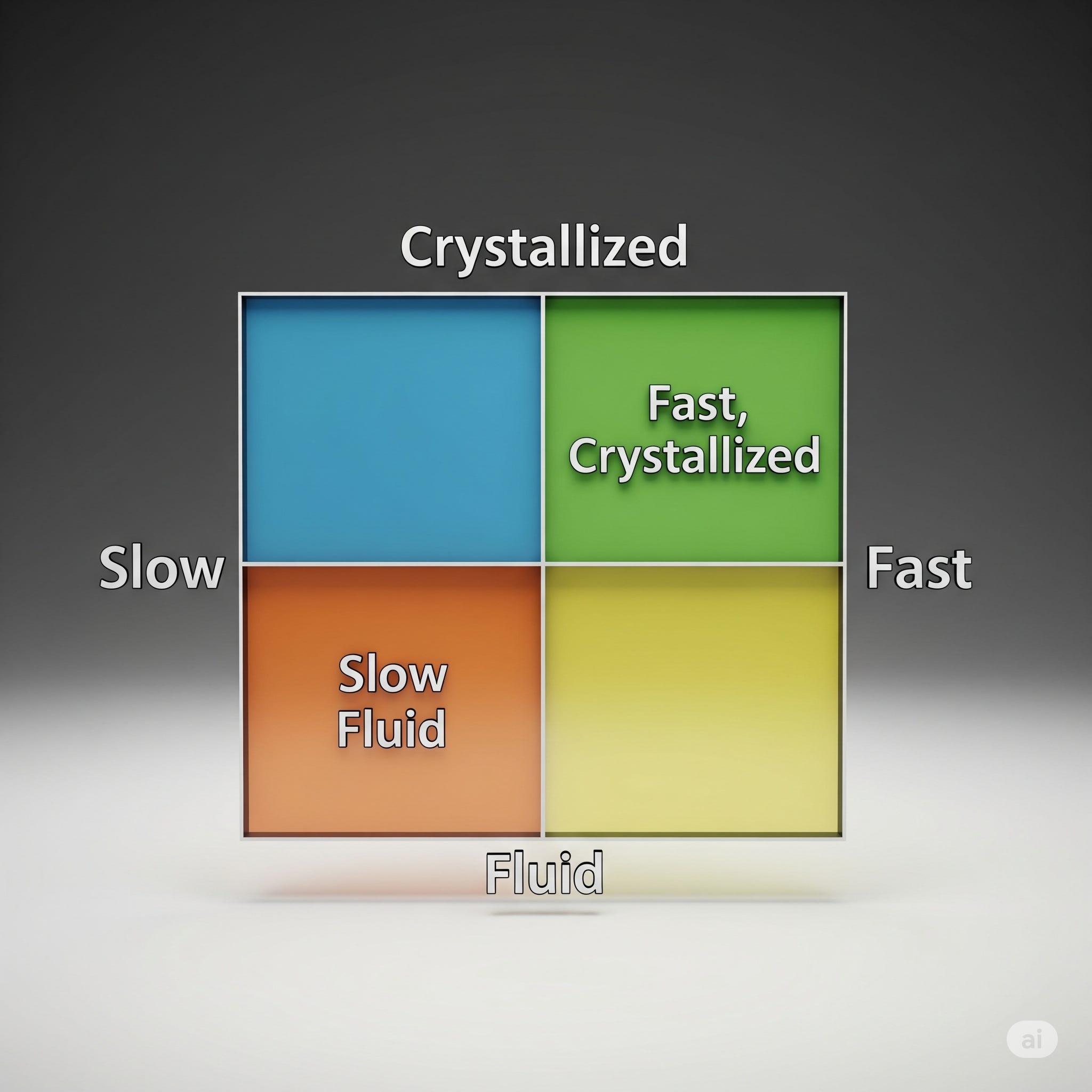
Fast vs. Slow × Fluid vs. Crystallized.
What you get isn’t two modes of thought. It’s four cognitive gears:
Fast–Fluid: flashes of creativity, intuitive leaps, sudden insights.
Fast–Crystallized: expert reflexes, habits, heuristics that run on autopilot.
Slow–Fluid: deliberate exploration, building models, running counterfactuals.
Slow–Crystallized: codifying knowledge, writing rules, formalizing best practices.
Each of these gears is powerful. Each has its place. And each comes with risks if we overuse it.
The ER doctor who thrives in Fast–Crystallized can miss a rare diagnosis.
The strategist who loves Slow–Fluid can drown in endless scenarios.
The startup founder living in Fast–Fluid may never ship.
The bureaucrat entrenched in Slow–Crystallized may resist necessary change.
The challenge isn’t whether to think fast or slow. It’s whether we can shift into the right gear at the right time.
Why We Get Stuck
Here’s the uncomfortable truth: most of us spend our lives locked into one or two gears.
We lean on reflexes that once served us, even when the environment has changed.
We explore endlessly without distilling insights into usable rules.
We automate too early, turning untested hunches into rigid habits.
We fail to notice when our mental playbooks have gone stale.
Being “smart” doesn’t save you from this. In fact, intelligence can make it worse: the sharper the tool, the deeper the rut it can carve.
A Different Kind of Mastery
The real mastery is not IQ, EQ, or even creativity.
It’s gear control — the skill of switching modes deliberately.
This is the thesis of both my upcoming book and this blog series:
You don’t need to “always slow down” or “trust your gut.”
You need a system for knowing which gear to use, when to switch, and how to train each mode so it’s available when you need it.
Think of it as Cognitive DevOps:
Explore new problems (Slow–Fluid).
Distill what works into principles (Slow–Crystallized).
Compile those principles into habits (Fast–Crystallized).
Monitor for weak signals that the world has changed (Fast–Fluid).
Re-compile when necessary.
This isn’t abstract theory. It’s a cycle you can run deliberately — in your personal decisions, in your team culture, even at the scale of entire organizations.
What This Series Will Cover
Over the next several weeks, I’ll share a sequence of posts that unpack this framework. Here’s the roadmap:
The Myth of “Think Fast or Think Slow” — why speed isn’t enough.
Fluid vs. Crystallized Intelligence — the overlooked dimension.
The Four Gears of Thinking — the full 2×2 revealed.
Why We Get Stuck in the Wrong Gear — common traps and failure modes.
Cognitive DevOps — how to compile and re-compile your mind.
How to Know When to Switch Gears — the Switchboard: volatility, cost, evidence.
Training Each Gear — practical exercises to strengthen your cognitive toolkit.
Liquid vs. Solid Thinking — the big idea, and how to live it.
Each post will be a teaser — enough to shift how you think, but not the full system. For that, you’ll need the book.
The Big Promise
If there’s one idea I want you to take away from this introduction, it’s this:
Don’t just think faster. Don’t just think slower.
Learn to shift gears. Be liquid when the world changes. Be solid when it’s time to deliver.
That’s the future of decision-making. And it’s a skill you can train.
👉 Next week: “The Myth of Think Fast or Think Slow.”
⚡ Question for you:
Which gear do you think you overuse — and which one feels hardest to access?