

For years, the phrase “a robot took my job” has conjured images of machines replacing workers on a factory floor. But as generative AI integrates into every corner of the modern workplace, the real story is proving to be far more complex and surprising.
This isn't just about eliminating jobs; it's a measurable, seniority-biased technological shift that is dismantling the very first step of the career ladder and rewriting the rules of professional apprenticeship in real time. The comfortable, predictable career ladder is being dismantled and rebuilt before our eyes.
Based on a wave of new research, here are five of the most impactful, counter-intuitive, and crucial truths that everyone—from students to executives—needs to understand about the future of their career.
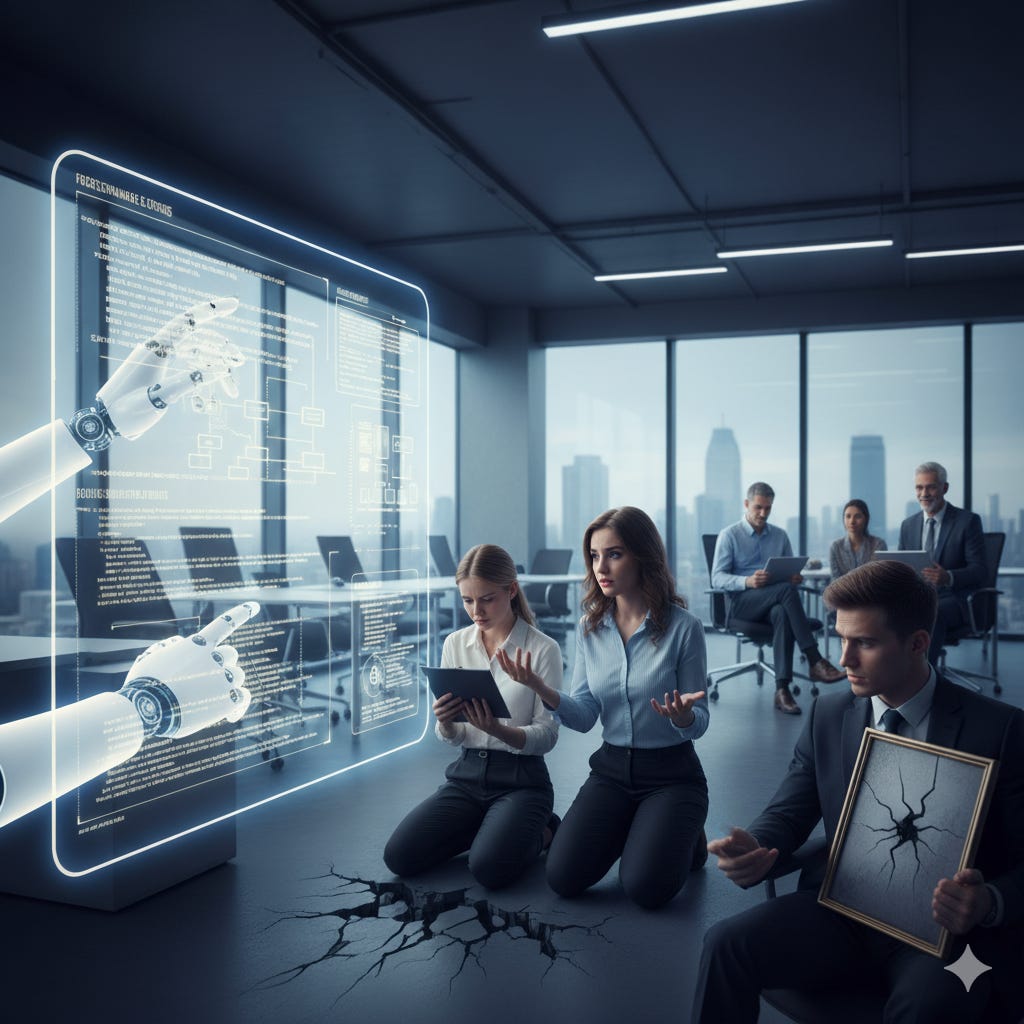
The First Rung of the Career Ladder Is Disappearing
Entry-level jobs have long served as a professional apprenticeship. Novices learn by doing the routine "grunt work"—drafting reports, reviewing documents, entering data, or debugging code—under the guidance of senior colleagues. This hands-on experience is where they gain the practical skills and tacit knowledge essential for long-term development.
But these low-complexity, high-frequency tasks are precisely what generative AI can do cheaper and faster. This creates what researchers call the 'apprenticeship paradox': the very "grunt work" that has historically served as the training ground for novices is being eliminated, eroding the traditional pathway to building tacit knowledge and expertise. The impact is already visible. Research shows this isn't due to mass layoffs, but rather a sharp slowdown in the hiring of new, entry-level talent in AI-exposed fields.
With this first rung of the ladder eroding, the traditional pathway to building expertise is in jeopardy. If AI becomes the new apprentice, it raises a critical question for companies and young professionals alike: How do human rookies learn?
The Biggest Risk Isn't for the Most Vulnerable—It's for the Middle
A common assumption is that AI automation will most impact graduates from lower-tier or less-selective institutions. However, a major study analyzing data from 62 million U.S. workers revealed a surprising, "U-shaped" pattern.
The steepest decline in demand for junior workers was for graduates of "mid-tier" universities (Tiers 2 and 3). Graduates from elite (Tier 1) and less-selective (Tier 4 and 5) universities were less affected. This is likely because graduates from elite universities often secure strategic roles that involve less routine work from day one, while graduates from less-selective universities tend to enter roles and industries less exposed to cognitive automation.
The analysis concludes that AI adoption is "disproportionately penalizing the broad upper-middle class of the human capital distribution"—the very people who followed the traditional path by attending a good, but not Ivy League, school. These are the roles where routine cognitive tasks are most easily automated, placing this group in an unexpectedly vulnerable position.
Today's Productivity Boost Could Be Tomorrow's Economic Decline
The immediate productivity boost from AI automation hides a dangerous long-term trade-off: a hidden tax on our collective expertise that could lead to decades of economic decline. The efficiency comes at the cost of disrupting the intergenerational transfer of "tacit knowledge"—the practical, hard-to-codify insights passed from experts to novices through hands-on work.
The long-term economic forecast is striking. One back-of-the-envelope calculation suggests that automating 30% of entry-level tasks in an aggressive adoption scenario could deliver initial productivity gains of around 7% within a decade. However, by eroding the skill-building pipeline, the same change could cause the economy's output to fall nearly 20% below the no-automation baseline after 100 years.
This challenges the optimistic view that AI will automatically lead to higher growth. It frames the loss of apprenticeship opportunities not just as a career issue, but as a major societal challenge that requires careful management to avoid eroding our collective expertise.
Getting Hands-On with AI Can Actually Make People More Skeptical
While many professionals have a welcoming attitude toward AI in theory, direct experience can tell a different story. In an exploratory workshop with design students, a hands-on experience with AI tools caused some participants to become more skeptical of the technology. Crucially, these unfavorable shifts in opinion were far more substantial than the positive shifts.
A key factor was trust. Students struggled to trust AI suggestions, demonstrating how negative first experiences can have an outsized impact. This highlights the critical challenge of trust calibration. A negative first experience can lead to 'under-trust,' causing users to abandon powerful tools and miss their benefits, a risk just as significant as over-relying on imperfect AI. As one student participant noted, AI is best viewed as a source of inspiration, not a replacement for human judgment.
AI Tools can’t replace a proper concept-driven design process - but I think it can really enrich it. If the designer knows how and when to use it, it can show us possibilities that we have not thought of before. But we should treat the results carefully and use them more as an inspiration.
The Fastest Way Up the Ladder Isn't Around AI—It's Through It
Despite the challenges, the final truth offers a clear and powerful path forward. In a surprising twist, research shows that in firms actively adopting AI, the promotion of junior workers into more senior roles has actually increased.
This surprising surge in promotions is happening because the nature of entry-level work is transforming. The job is evolving from a 'Technician,' who manually executes routine tasks, to an 'AI Orchestrator,' who designs, supervises, and validates AI-driven workflows. By directing AI to handle the mundane work, junior employees are freed up to focus on higher-level activities like complex problem-solving and strategic thinking—the very skills required for senior roles.
The path forward isn't to compete with AI, but to master it. For those who can shift their mindset from a "doer" to a "copilot," the prize is a faster, more direct path to senior roles and greater responsibility.
Conclusion: Reshaping Our Future
The impact of AI is not a simple story of job replacement. It is a fundamental restructuring of careers, a redefinition of skill, and a challenge to how we think about economic growth itself. The predictable, step-by-step career path that defined generations of work is being replaced by a more dynamic and demanding landscape.
This transformation requires us to think differently about how we build value and expertise. As the traditional career ladder is being dismantled and rebuilt, how will we—as individuals, companies, and educators—redesign the first decade of a person's career to build the human judgment AI can't replicate?
References
Barroso, C. J. (2025). From Grunt Work to Governance: Re-skilling Juniors as AI Orchestrators. ResearchGate. https://doi.org/10.13140/RG.2.2.14680.97281